



Submitted by Alli Behnke, HKYFS
(March 10, 2026) — Haddam-Killingworth youth in grades K-5 were invited to participate in a fun poster contest designed to raise awareness about the Global Day of Unplugging. Representatives from the HK Youth Unplugged Community Group judged more than 80 submissions, each one unique in its desire to highlight the importance of childhood, play, and creativity. HKYFS and HK Youth Unplugged wish to highlight and celebrate our kids and families who are purposefully unplugging from devices and finding ways to connect in community and get involved in activities they enjoy. We are all hearing about the impact that a digitally fast-paced and social media-driven world is having on our youngest community members. This artwork serves as a powerful reminder that our youth and families are resilient and empowered to thrive. While we selected a top poster for each grade, all participants are role models for the whole community.
Top Posters
Burr Elementary School
K Everett Baklik
Grade 1 Lyla O’Brien
Grade 2 Gibson Rosalie
Grade 3 Claire Gallagher
Killingworth Elementary School
K Reid Romano
Grade 1 Stella Dombroski
Grade 2 Mila Leatherman
Grade 3 Chloe Rochester
Haddam Killingworth Intermediate School
Grade 4 Madeline Major-Betteridge
Grade 5 Karis Torneo
Home School
Rowan Patch
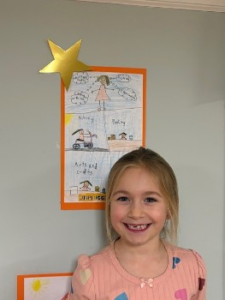
(Photo above, Stella Dombroski, Killingworth Elementary School, Grade 1)
All submitted artwork is currently on display at Brainerd Memorial Library (Haddam residents) and Killingworth Library (Killingworth Library). Families celebrated Global Day of Unplugging on March 6, 2026 by attending a lovely Art Show highlighting their children’s posters and the messages they portray.
Children and adolescents spend a lot of time watching screens, including smartphones, tablets, gaming consoles, TVs, and computers. On average, children age 8-18 in the United States spend 7 1/2 hours a day watching or using screens. While screens can entertain, teach and keep children occupied, too much use or the wrong content may lead to problems. (American Academy of Child and Adolescent Psychiatry).
Research continues to pour in and informs that too much screen time may lead to concerns with sleep, lowered grades, less reading, less time with family and friends, reduced physical activity, challenges with mental health, poor self-esteem/body image, fear of missing out, and loss of coping skills for boredom, relaxation and communication.
HK Youth Unplugged is a parent-led group that aims to bring community awareness to the importance of responsible technology use and the importance of a play-based childhood. They team up with HKYFS to educate, support and provide opportunities for families to get together, have fun and connect. Local parent Alicia Rosalie says, “It’s great to be in a community where there are events specifically encouraging families to unplug. Studies are clear that too much screen time and social media access at a young age are detrimental to brain development. Still, I expect we’ll worry a little about our kids being left out when they get older and are asking for social media accounts and smartphones, and we tell them no. It’s wonderful to know there are lots of families in our community doing the same thing, and that we’ll be meeting through HKYFS programming.”
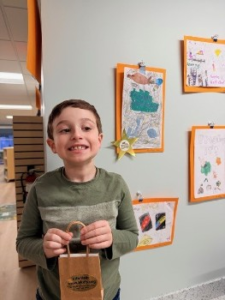
Her son, Gibson Rosalie (photo above), a student at Burr Elementary School, says that one of the reasons he likes to be creative and not always be on screens is “because you can make stuff if you’re not watching TV, and screens can hurt your eyes.” Gibson was one of the Unplugged Poster Contest winners, but was joined by many of his friends and peers to showcase why they value “unplugging.” It’s a great sign of change and growth!
“The good news is that the data we are all seeing is starting to impact family decisions, as well as policies shifting in the school setting. My hope is that young families will continue to reduce screen time, encourage a slower, play-based childhood, and hold off on personal devices and social media until much later. Taking these steps is much easier if families do it together,” said Alli Behnke Director HKYFS.
Suggestions from HK Youth Unplugged
Disconnect: Considerations for Screen Use
- model appropriate technology use
- set designated times and spaces that are screen/phone free
- employ a ‘digital sunset’ by limiting screen time before bed
- pause before picking up your phone
- go back to print publications and physical books
- keep devices out of reach when not needed
- turn off unnecessary notifications
- set limits on apps using device features
- monitor all family screen time (including your own!)
- remove apps that consume too much time and don’t bring value to your life
- lower the contrast on your phone or change it to grayscale
- replace screen use with unplugged hobbies or activities
- narrate what you do when you use technology in front of your kids
Reconnect: Reclaim Connection with Your Kids in a Busy, Tech-Filled World
- foster independence by allowing your child to help with chores, shopping, cooking
- read with your child every night
- give your child opportunities to play in a way that they choose
- connect by discussing a successful part of the day and a challenging part of the day
- make a realistic screen time plan together
- avoid using screens during family times like meals
- use screens together as a shared experience
- avoid using screens during busy times that require your attention to your child, like transitions
- have a family game night, spend time outside, visit the park, the beach, or the playground, etc.
- visit the library and community events to check out all the unplugged activities
Rules are important, but sharing stories from the news, books, and concrete data will help your kids understand your limits and expectations. More resources are available on the HKYFS website, www.hkyfs.org. HKYFS is proud of all the submissions to the Unplugged Poster Contest and we hope others are inspired by the kids and families who are taking purposeful steps to stay unplugged!
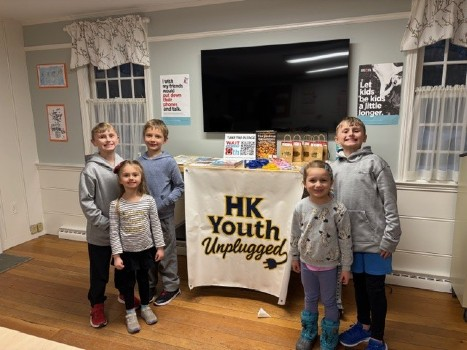
Photos provided by HKYFS. Above, left to right: Matthew Roby, James Chanko, Katherine Riby, Mark Roby, Vivian Chanko


