


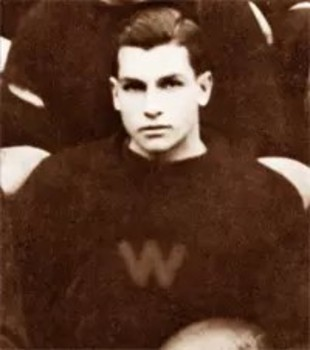

By Philip R. Devlin
(February 4, 2026) — It’s Super Bowl week and much of the nation’s attention will be focused on Super Bowl LX on Sunday, February 8, 2026, pitting the resurgent New England Patriots against the Seattle Seahawks. Much of the game’s focus is on the quarterbacks for each team, Drake Maye of the Patriots and the much-travelled Sam Darnold of the Seahawks, and justifiably so, as modern football has evolved into a game centered around the forward pass. Fifty of the past fifty-seven NFL Players of the Year have been quarterbacks, including the past twelve in a row. Similarly, eight of the past ten Heisman Trophy awards for college football’s best player have been won by quarterbacks, again reflecting the emphasis on pass-heavy offenses that characterize modern football.
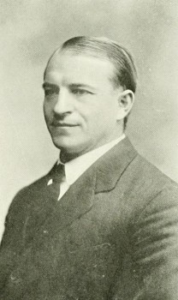
American football as we know it, however, hardly centered around the overhand forward pass in its early years when running and kicking were used almost exclusively. That began to change in 1906 when the forward pass first became a legal play in collegiate football since the sport’s inception in 1869. Though it is impossible to say with 100% certainty who the very first practitioner of the forward overhand pass was, many historians of the game point to Wesleyan University in Middletown and their innovative coach, Howard “Bosey” Reiter (photo above), a former All-American player at Princeton.
In the opening game of the 1906 season against Yale, Reiter’s quarterback, Sammy Moore, completed a forward pass to Irvin van Tassell for a 30-yard gain. The New York Times called it “the prettiest play of the day,” as Wesleyan’s quarterback “deftly passed the ball past the whole Yale team to his mate Van Tassel.” Thus, the forward pass soon became the central strategy behind the offense of Wesleyan’s football team.
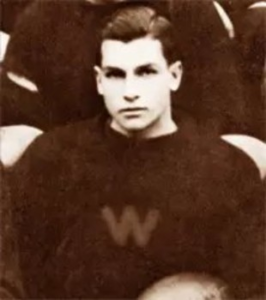
Even after Howard Reiter left Wesleyan to coach elsewhere, the forward pass continued to be a central offensive tactic at Wesleyan, especially in the hands of legendary Wesleyan quarterback, C. Everett Bacon of Westbrook (photo above), a member of the Class of 1913. Bacon was a multi-talented athlete who was a two-time All-American football player and attended Middletown High School. His frequent use of the forward pass was described at the time as a “lethal weapon.” Bacon’s name lives on at Wesleyan. Since 1936 the most valuable player of the Wesleyan football team has been given the C. Everett Bacon Award. The 70,000 square foot Bacon Fieldhouse bears his name. Ev Bacon lived to be nearly 99, dying in 1989. He is buried at the Indian Hill Cemetery in Middletown.
Thus, the forward pass-heavy offense that characterizes modern American football and will certainly be on display at the Super Bowl can in large part be attributable to Wesleyan University’s innovative Coach Howard Reiter and to one of its finest athletes, Ev Bacon, whose frequent use of the overhand forward pass as a “lethal weapon” earned him All-American status and a legendary place in Connecticut athletic history!
Photos in Public Domain, provided by Philip Devlin


