



By Clark Judge
(January 26, 2026) — If Killingworth residents don’t know what an AED is, they should know where to find one. That’s because AEDs — otherwise known as Automatic External Defibrillators — aren’t exactly hard to find in their town.
They’re everywhere.
Public Parks? Check. They’re visible at Sheldon, Rocco Real Field and Eric Auer Park. Town Library? Bingo. Look behind the circulation desk. Town Hall? Walk through the front door, take a left and you’ll find one next to the black water dispenser. AEDs are at Parmelee Farm and True Value, too, as well as St. Lawrence and the Killingworth Congregational Church. Bottom line: You name it, one is probably there … and it should be.
Because AEDs can save lives.
What is an AED? It’s a portable electronic device that measures an individual’s heart rhythm during cardiac arrest, delivering electronic shocks (defibrillation) to the heart to restore a normal rhythm. The kit includes verbal and written instructions, making it usable for bystanders with minimal training, and is as easy to access as it is critical to operate.
“According to the American Heart Association,” said the Killingworth Ambulance Association’s Chief of Service, Mike Haaga, who helped install most of them, “one of the most important steps in the chain of survival is early defibrillation. If you can defibrillate in the first three minutes of cardiac arrest, you have an 85-90 percent chance of survival. But for every minute lost after that, it goes down by 10 percent.”
Haaga speaks from experience, and not because he’s an EMT. His younger brother, George, suffered cardiac arrest nine years ago. According to Haaga, George was home sitting in a recliner when his heart suddenly stopped. Fortunately, his son was there and immediately called 911, with the Hamden Fire Department responding and resuscitating him with an AED.
Now 61, George has suffered no residual effects from the incident and, according to his brother, ”is back to his old self.”
“Could he have survived without an AED involved?” Haaga was asked. “Absolutely not,” he said. “So, it makes a difference.”
The first AED in Killingworth was installed years ago by the town’s ambulance association, but no one is exactly sure when. However, there’s no such mystery about the latest device. It was positioned late last year at Parmelee Farm, with the town anchoring one on the north outside wall of the property’s pavilion. In a yellow box, it’s easy to recognize — with the words “LIFE SAVING AED” printed across the top and “AED” in bold red letters on either side.
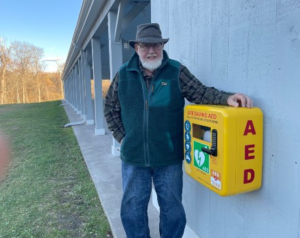
“The main reason for its being here,” said Parmelee Farm board member Tim Gannon (photo left), “is to make sure people are protected if they have a heart issue. We have a lot of events here, and it’s easily accessible. So we’re happy to have it.”
Three years ago, CPR and an AED played central roles in saving the life of Buffalo Bills defensive back Damar Hamlin in a nationally televised NFL game. Hamlin suffered cardiac arrest after making a tackle in the first half and was resuscitated on the field by EMTs and club personnel. Hamlin not only recovered, he returned to the Bills a year later and was a starter by 2024.
“One of the reasons Hamlin had such good neurologic outcomes and a week later was tweeting with friends,” said Dr. Mary Ann Peberdy, a professor of medicine and emergency medicine at Virginia Commonwealth University, in an interview with the American Heart Association, “was that he had early CPR and early defibrillation. Unequivocally, these devices save lives, and Hamlin is a perfect example of that.”
So was Mike Haaga’s brother, and so was my brother. He was saved by an AED in 2019 after suffering cardiac arrest at a Chicago fitness center. Like George Haaga, he made a complete recovery, and he continues to work today.
“If someone’s heart stops beating,” said KAA president Dan O’Sullivan, “they can be impossible to resuscitate by the time an ambulance gets there. But if a bystander on the scene sees what’s happening and uses an AED, a life can be saved.”
Photo by Clark Judge


