



By Philip R. Devlin
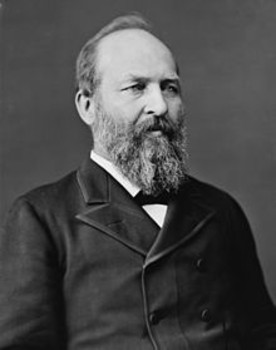
(November 19, 2025) — November 19th is most famous in American history as the date on which President Lincoln gave his brilliant Gettysburg Address; however, it should also be recognized as the birthday of our twentieth President, James A. Garfield, an extraordinarily talented and interesting visionary.
My Windsor Locks High School geometry teacher was named Mrs. Josephine Oates. Her maiden name was Preli, a well-known name in town. Her best friend since childhood was Ella Tambussi, whose married name was Ella T. Grasso. Both women attended Mount Holyoke College. Ella majored in economics and later famously held several important political offices, while Josephine majored in mathematics and became a teacher.
It was at Mount Holyoke that Mrs. Oates developed an appreciation for Garfield, not in a history or a political science class, but in her study of geometry. Garfield, you see, was a brilliant mathematician who published an important paper in April of 1876 in the New England Journal of Education about a proof called the “Pons Asinorum.”
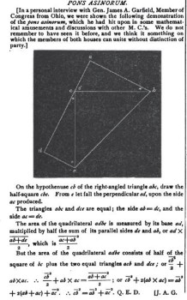
Using a trapezoid, Garfield’s proof of the Pythagorean Theorem essentially consists of a diagram of a trapezoid with bases a and b and height a + b. He looked at the area of the diagram in two different ways: as that of a trapezoid and as that of three right triangles, two of which are congruent. When my class was studying the Pythagorean Theorem, Mrs. Oates mentioned Garfield’s proof and said, “You know, you people ought to pay more attention to President Garfield. He was such an interesting man.”
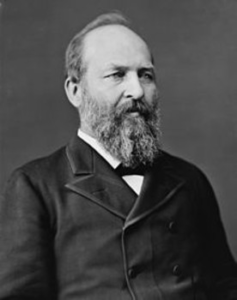
I always remembered what she said about Garfield and, over the years, became fascinated with his many interesting qualities. Like DaVinci and Michelangelo, he was a natural left hander but had an amazing degree of ambidexterity. While a student at Williams College, he used to entertain others by writing in two different languages simultaneously—Latin with his left hand and Greek with his right hand! He was multilingual and is the only President to have given a campaign speech completely in a foreign language—German.
A Civil War hero of the 42nd Ohio regiment, despite having no military background, Garfield used his mathematical mind to outmaneuver a Confederate general with a West Point education at the Battle of Middle Creek in Kentucky even though his regiment was vastly outnumbered! He created a ruse by employing a staggered three-sided attack that made the Confederate commander — a West Point grad — believe that he was outnumbered. The rebels withdrew despite vastly outnumbering Garfield’s regiment. Kentucky was saved, and Garfield was soon promoted to general.
Garfield was more than six feet tall and weighed about 210 pounds. He was a large, athletic man, especially for his time. Garfield’s physical size was matched by the size of his character. Generous and kind-hearted by nature, he was beloved and respected by all who knew him. Loyal and self-effacing, he never sought the presidency but ended up being drafted against his will as a compromise candidate by the hopelessly deadlocked delegates of the Republican National Convention in June of 1880.
Among the first to cast key votes to turn the deadlocked convention toward Garfield were the eleven members of the Connecticut delegation—led by former Connecticut Governor Marshall Jewell, the chairman of the national Republican party– who had been moved earlier by Garfield’s eloquent nominating speech for his fellow Ohioan, John Sherman—the younger brother of famed Union General William Tecumseh Sherman.
Three days after Garfield was drafted as the Republican candidate for president, a deeply troubled man named Charles Guiteau boarded a steamship in Stonington, Connecticut bound for New York City. Off the coast of Old Saybrook, his ship, the S.S. Stonington, collided with its sister ship, the S.S. Narragansett on a very foggy night. The fiery inferno that followed resulted in at least 30 deaths and scores of injuries. The delusional Guiteau took his survival as a sign from God that he was to carry out a divine mission to assassinate James Garfield.
Guiteau began to stalk Garfield, and just over a year later, on July 2, 1881, he fatally wounded the new President in a Washington, D.C., train station. Shot both in the arm and in the back, President Garfield survived the attack for 80 days before finally succumbing on September 19, 1881, to an overwhelming infection brought about by unsanitary medical practices. Garfield was exactly two months shy of his 50th birthday.
President Garfield and all four of his sons were graduates of Williams College. Another Williams grad, Cyrus W. Field, son of David Dudley Field of Haddam, and famous for laying down the first trans-Atlantic telegraph cable, set up a trust fund of $350,000 (the modern equivalent of over $9 million dollars) for Garfield’s widow, Lucretia, and their five surviving children to live on.
That Cyrus W. Field and so many others would be moved enough by Garfield’s death to establish a trust fund for his family can be explained by the remarkable achievements, character, and most interesting nature of James A. Garfield. He was quite a man, and his interesting life is now being brought to the attention of Americans in the newly released four-part docuseries on Netflix called “Death by Lightning.” It is well worth watching.
Photos in the Public Domain


Fascinating story, Mr. Devlin.
I’ve enjoyed your writing.
Look ahead to your next article.